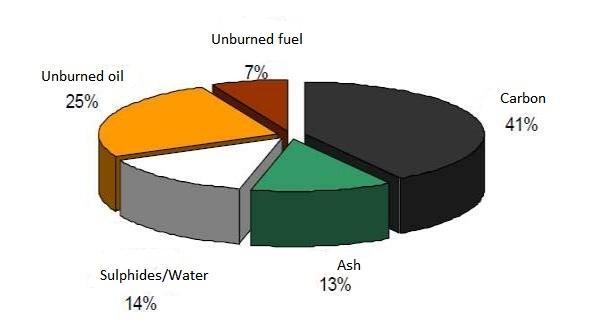
The composition of the exhaust of diesel vehicles varies and depends on a number of factors such as the quality of the fuel, the engine type, driving behavior, whether there are or not anti-pollution systems etc.
The particles from the combustion of diesel consisting mainly of carbonaceous material (soot) produced by combustion, in which some organic ingredients, mostly from unburned fuel and lubricant motor oil, are absorbed. Particles are distributed in a wide range of sizes from 10mm to 20nm which makes them breathable.
The rate of soot particles from the extraction of a Diesel engine varies , but is usually higher than 40-50%. Other substances contained in the particles are: unburnt fuel or engine lubricating oil derived from partial combustion, metal debris from wear and salts derived from fuel.
The existing regulations for particulate emissions are based on the mass of emitted particles. However, the size distribution of the particles increases the interest in terms of air quality, because it is assumed that the toxicity increases as the particle size decreases. The soot particles, on the order of 100nm, pose a risk to human health because their size is small enough to be absorbed by the nose and large enough to deposited to the lungs.